
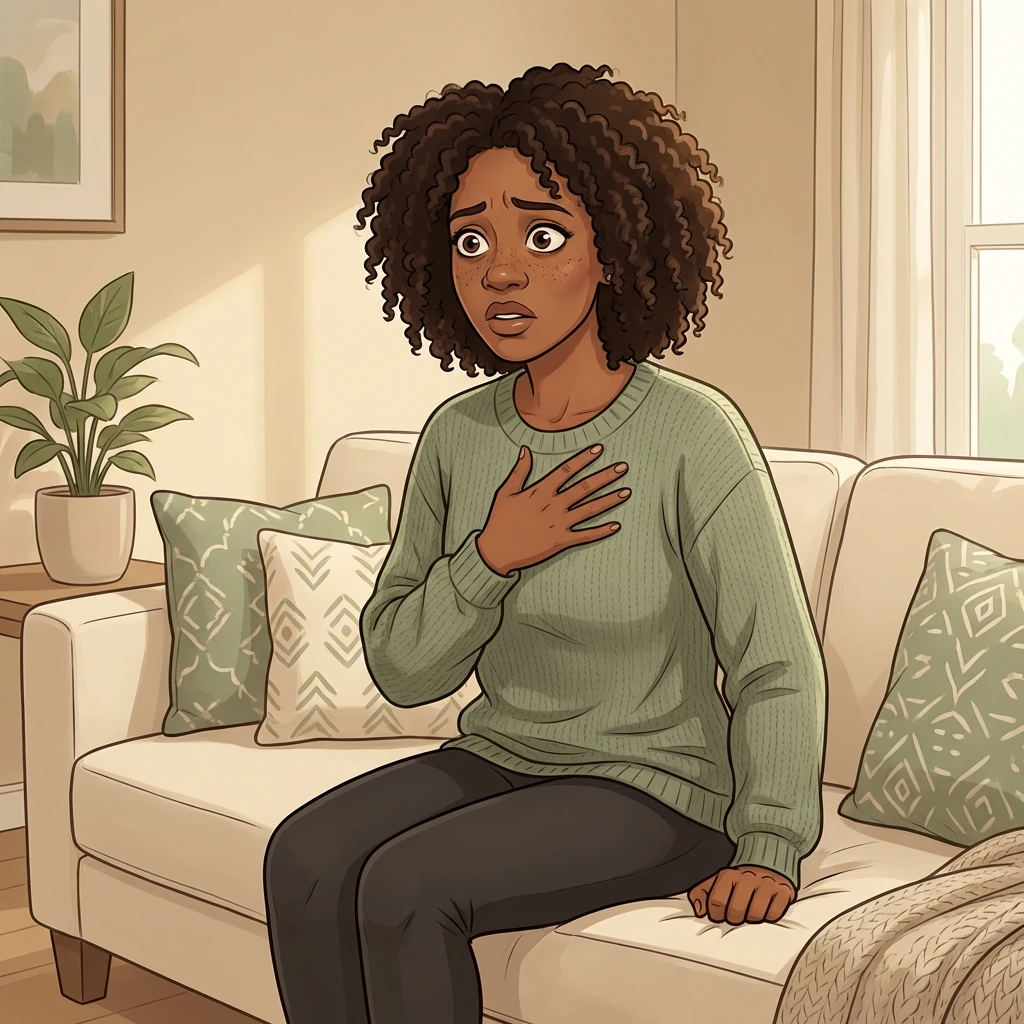

This Doesn't Feel Like "Worry" — It Feels Like Something Is Wrong
Anxiety during perimenopause doesn't always look like what you'd expect. It's not necessarily about worrying over a specific problem. It's subtler and stranger than that. A sense of unease that follows you through the day. A tightness in your chest when you wake up. The feeling that something bad is about to happen — except nothing is.
Some women experience it as a vibrating energy that won't settle. Others describe sudden waves of panic that come from nowhere — heart pounding, shortness of breath, a rush of adrenaline that makes no sense given the situation.
What makes it particularly disorienting is that it's new. You've handled stress your whole life. You've navigated difficult jobs, raised children, managed crises. Anxiety was never your thing. So when it shows up uninvited in your forties, the first instinct is to look for an external cause.
That's the hormonal piece most women don't hear about until they're already sitting in a therapist's office or staring at an SSRI prescription.
"I've managed stress my entire career. Then one day I couldn't get out of the parking lot because my chest was so tight."
— Age 43
Progesterone Is Your Natural Anti-Anxiety System — and It's Disappearing
Progesterone is the calming hormone. It enhances the effect of GABA — your brain's primary inhibitory neurotransmitter, the one responsible for making you feel relaxed, grounded, and able to handle stress without spiraling. Think of GABA as your nervous system's brake pedal. Progesterone makes that brake pedal work better.
During perimenopause, progesterone is typically the first hormone to decline — and it can drop significantly before estrogen does. When progesterone falls, GABA activity decreases. Your nervous system loses some of its natural buffering capacity. Stressors that you used to absorb without much effort now hit differently.
Estrogen fluctuations add another layer. Estrogen modulates serotonin — the neurotransmitter associated with mood stability and emotional resilience. When estrogen surges and crashes unpredictably, serotonin signaling becomes unstable.
The combination of declining progesterone and fluctuating estrogen essentially rewires your stress response system. Your amygdala — the brain's threat detection center — becomes more reactive. Your prefrontal cortex has less chemical support to override fear signals. The result feels like your emotional thermostat is broken.
How It Happens
Hormones Are Central — But They're Not Always the Whole Story
Perimenopause creates the conditions for anxiety, but other factors can amplify it substantially.
Sleep disruption has a profound effect on anxiety. When you lose deep sleep, your brain's emotional regulation circuits become less effective. A single night of poor sleep increases amygdala reactivity by roughly 60 percent.
Blood sugar instability is an underappreciated driver. When blood sugar swings, your body releases adrenaline and cortisol to bring glucose back up. Those are the same chemicals that produce anxiety symptoms.
Thyroid overactivity can mimic or worsen anxiety. Heart palpitations, restlessness, heat sensitivity, and nervousness are all thyroid symptoms that overlap with perimenopause.
Cortisol dysregulation from chronic stress means your adrenal system is already running hot when perimenopause hits. The hormone changes push it past its capacity.
"They put me on an antidepressant. It helped a little. Then I found out my progesterone was basically at zero."
— Age 41
Thyroid Dysfunction
Hyperthyroidism and thyroid swings can produce anxiety, heart racing, and restlessness that mirrors perimenopause anxiety.
Ask about: Full thyroid panel including antibodies
Blood Sugar Instability
Reactive hypoglycemia triggers the same fight-or-flight response — shakiness, racing heart, panic.
Ask about: Fasting insulin, glucose, HbA1c
Sleep Deprivation
Poor sleep amplifies amygdala reactivity by up to 60%, making everything feel more threatening.
Ask about: Sleep study if apnea suspected
When to See a Provider Promptly
- •Anxiety is constant and debilitating
- •Accompanied by thoughts of self-harm
- •Preventing you from functioning
- •Accompanied by significant heart symptoms
Making Your First Conversation Count
Anxiety is one of those symptoms that can be hard to articulate in a medical appointment. Tracking a few things beforehand helps you communicate clearly.
Note when anxiety is worst. Time of day matters. Morning anxiety that improves through the day often relates to cortisol patterns. Premenstrual worsening points to progesterone. Random waves with no pattern may reflect estrogen fluctuations.
Describe the physical sensations. Tight chest? Heart racing? Trembling? GI symptoms? These physical manifestations help distinguish hormonal anxiety from other causes.
Track your cycle if you're still having periods. Many women notice that anxiety intensifies in the luteal phase when progesterone should be rising but isn't.
Document what you've tried. Therapy, meditation, exercise, supplements, medications — your provider needs to know what's been attempted and what helped versus what didn't.
Symptom Tracker — Perimenopause Anxiety
Track these for 2–4 weeks before your appointment
💾 Save this tracker — bring it to your first appointment
We Look for the Cause Before Reaching for a Prescription
At Pause & Reset, we don't assume anxiety during perimenopause is a mental health problem that needs a psychiatric solution. We investigate it as a physiological event — because that's usually what it is.
Our evaluation starts by understanding your hormonal landscape. Where are your progesterone levels relative to where they should be? What pattern are your estrogen fluctuations following? We also assess thyroid function, cortisol rhythm, blood sugar dynamics, and nutrient levels.
Dr. Nina has seen hundreds of women whose anxiety resolved or dramatically improved once the right hormonal and metabolic factors were addressed. For many women, progesterone support alone makes an enormous difference — because restoring GABA activity gives the nervous system back its ability to self-regulate.
What we don't do is hand you an SSRI as a first-line response without first understanding whether your serotonin pathways are actually the problem. For some women, an antidepressant is the right tool. But for many perimenopausal women, the anxiety isn't a serotonin deficiency — it's a progesterone deficiency.