

When Your Heart Gets Your Attention
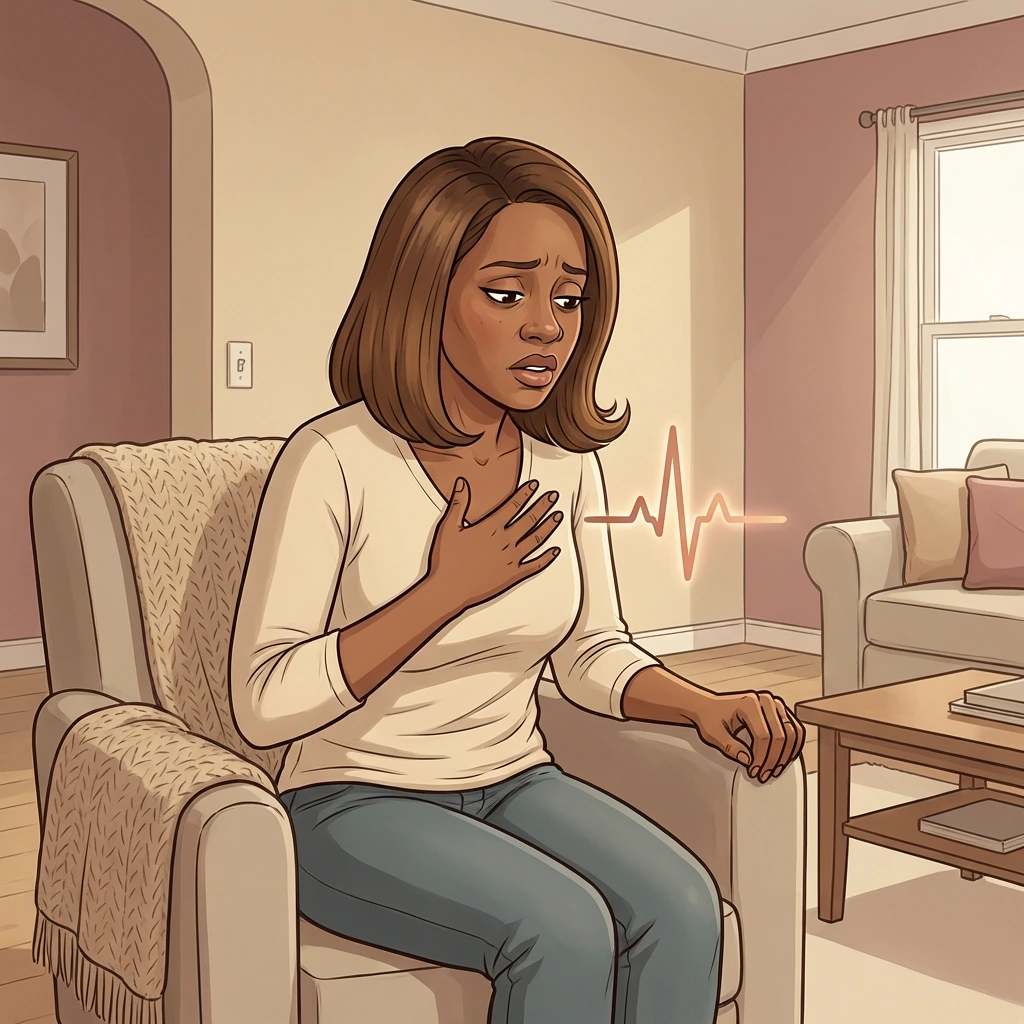
You're lying in bed, almost asleep, when suddenly you feel it — your heart hammering in your chest. Or skipping a beat. Or fluttering rapidly in a way that makes you hold your breath and wait.
Some women notice palpitations during the day — a sudden racing heart while sitting at their desk, a thudding sensation during a normal conversation. Others only experience them at night, particularly during the second half of their cycle or alongside hot flashes.
The fear response is immediate and primal. Your heart is the organ you associate with emergency. When it behaves unpredictably, your brain interprets it as danger — which releases adrenaline, which makes the palpitations worse.
Many women end up in the emergency room or at a cardiologist's office, where tests come back normal. Which is reassuring in one sense and deeply frustrating in another — because the palpitations are still happening and nobody has explained why.
"I was lying on the couch watching TV and my heart just started pounding. No reason. I called my husband in a panic."
— Age 43
Estrogen, Your Autonomic Nervous System, and Your Heart
Estrogen influences the autonomic nervous system — the branch that controls automatic functions including heart rate, blood pressure, and vascular tone. When estrogen fluctuates during perimenopause, autonomic regulation becomes less stable.
Estrogen also affects how your blood vessels respond to stimulation. With fluctuating estrogen, vascular tone can become more variable — producing moments where your heart compensates with rate or rhythm changes. This is closely linked to the vasomotor instability that causes hot flashes.
Progesterone decline adds to the picture. Low progesterone reduces GABA activity, which means your nervous system has less braking capacity. The sympathetic (fight-or-flight) branch becomes more dominant.
Cortisol and adrenaline play roles too. If chronic stress has your adrenal system running hot, you're pre-loading the conditions for palpitations. Add hormonal fluctuation on top of an already dysregulated stress-response system, and your heart pays the price.
How It Happens
When to Take Palpitations Seriously
Perimenopause is the most common cause of new-onset palpitations in women in their 40s and 50s, but it's not the only possibility.
Thyroid overactivity causes palpitations, rapid heart rate, and sometimes irregular rhythms. Thyroid function should be assessed in any woman with new palpitations.
Cardiac arrhythmias — while less common — do occur. If palpitations are accompanied by sustained rapid heart rate, chest pain, shortness of breath, dizziness, or fainting, cardiac evaluation is appropriate.
Caffeine, alcohol, and certain supplements can trigger or worsen palpitations. Caffeine sensitivity often increases during perimenopause.
Anemia and iron deficiency force your heart to work harder. If your periods have become heavier and your iron stores are depleted, palpitations may partly reflect compensation.
Anxiety and palpitations exist in a bidirectional relationship. Addressing both the hormonal driver and the anxiety component produces the best outcome.
"The ER said my heart was fine. But it kept happening. Nobody connected it to my hormones for another year."
— Age 45
Thyroid Dysfunction
Hyperthyroidism is a common cause of palpitations and must be ruled out — it's treatable but needs attention.
Ask about: Full thyroid panel with antibodies
Magnesium Deficiency
Magnesium is essential for heart rhythm regulation. Deficiency is common and easily correctable.
Ask about: RBC magnesium (not serum magnesium)
Cardiac Conditions
While most perimenopause palpitations are benign, cardiac evaluation provides peace of mind and safety.
Ask about: ECG, Holter monitor if symptoms are frequent
When to See a Provider Promptly
- •Palpitations accompanied by chest pain
- •Fainting or near-fainting
- •Sustained rapid heart rate
- •Shortness of breath
Information That Matters More Than You'd Think
When do palpitations occur? At rest, during exertion, at night, with hot flashes, before your period? Each pattern points toward different drivers.
How long do episodes last? A few seconds of fluttering is different from sustained rapid heart rate lasting minutes or hours.
What are the accompanying sensations? Just awareness of heartbeat? Or also chest tightness, shortness of breath, dizziness?
What triggers them? Caffeine, alcohol, stress, poor sleep, hot environments, exercise?
How frequent are they? Daily, weekly, occasional? Frequency helps your provider decide what level of evaluation is appropriate.
Symptom Tracker — Perimenopause Heart Palpitations
Track these for 2–4 weeks before your appointment
💾 Save this tracker — bring it to your first appointment
We Take It Seriously Without Jumping to the Worst-Case Scenario
At Pause & Reset, we recognize that heart palpitations are frightening — and we don't dismiss them with a casual "it's just hormones" without doing our due diligence.
We start with a thorough history and the lab work that matters: hormones, thyroid function, electrolytes (magnesium and potassium affect cardiac rhythm), iron studies, and inflammatory markers. If clinical features suggest a cardiac component, we refer for appropriate cardiac evaluation.
For the majority of women whose palpitations are hormonally driven, targeted hormonal support often reduces both the frequency and intensity of episodes. Progesterone support can calm an overactive nervous system. Estrogen stabilization reduces vasomotor fluctuations.
Dr. Nina's goal is to give you both reassurance and resolution. Reassurance that your heart is usually fine. Resolution by addressing the hormonal and metabolic factors that are causing it to behave this way.