
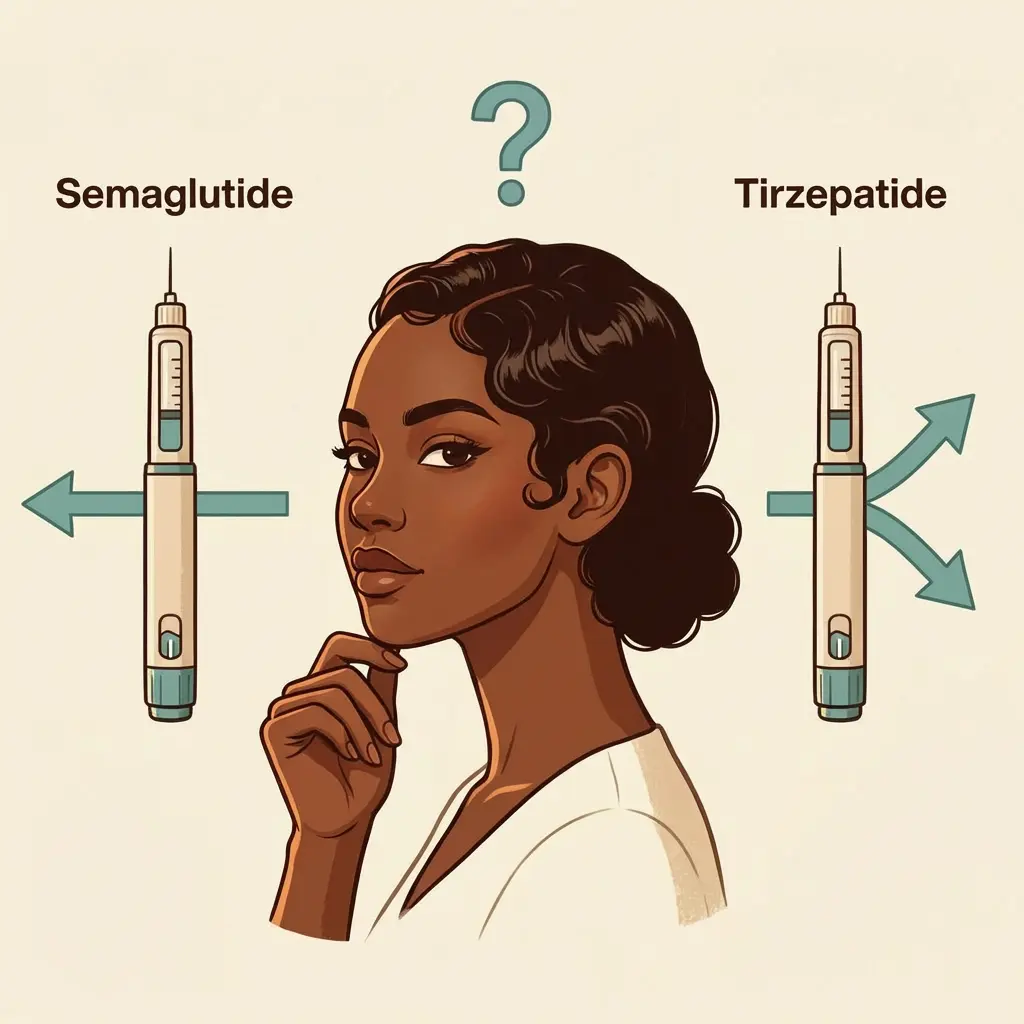

Two Medications, Two Mechanisms — Here's the Real Difference
Semaglutide and tirzepatide are both injectable weight loss medications, but they work through different mechanisms. Understanding the distinction matters — because the right choice depends on YOUR metabolic picture, not which drug got more press coverage.
Semaglutide is a GLP-1 receptor agonist. It activates one receptor pathway — GLP-1 — which reduces appetite, slows gastric emptying, and improves insulin sensitivity. It's the active ingredient in Ozempic (prescribed for type 2 diabetes) and Wegovy (prescribed for weight management). It's been on the market longer and has extensive clinical data supporting its efficacy and safety profile.
Tirzepatide is a dual GIP/GLP-1 receptor agonist. It activates TWO receptor pathways — both GLP-1 and GIP (glucose-dependent insulinotropic polypeptide). The dual mechanism provides two metabolic pathways of appetite regulation and insulin improvement, which is why clinical trials have shown greater average weight loss with tirzepatide compared to semaglutide. It's the active ingredient in Mounjaro (type 2 diabetes) and Zepbound (weight management).
In simple terms: semaglutide pushes one metabolic lever. Tirzepatide pushes two. But 'more levers' doesn't automatically mean 'better for you.' Your insulin resistance level, your metabolic profile, your side effect sensitivity, and your hormonal status all factor into which medication will produce the best results with the least disruption.
"My first provider put me on semaglutide without checking anything else. I lost 15 pounds in 6 months. When I switched to Pause & Reset, they ran labs, found my insulin was sky-high, moved me to tirzepatide and added hormonal support. I lost 30 more pounds in 4 months."
— Age 51
Head-to-Head: What the Research Actually Shows
The SURMOUNT and SURPASS trial programs (tirzepatide) and the STEP trial program (semaglutide) provide the most comprehensive comparison data available. Here's what the research tells us — without the hype.
For weight loss at the highest approved doses: semaglutide 2.4mg (Wegovy) produced approximately 15-17% body weight loss over 68 weeks in clinical trials. Tirzepatide at its highest dose (15mg) produced approximately 20-25% body weight loss over 72 weeks. On average, tirzepatide produces more weight loss — but the gap narrows at lower doses, and individual response varies significantly.
For insulin sensitivity: both medications improve insulin response, but tirzepatide's dual GIP/GLP-1 mechanism may provide stronger insulin sensitization, particularly in women with significant insulin resistance. For women in perimenopause whose estrogen-related insulin resistance is a primary driver, this dual mechanism can be particularly relevant.
For side effects: the profiles are similar. Both cause gastrointestinal side effects — nausea, constipation, decreased appetite, occasional diarrhea — primarily during dose escalation. Some data suggests tirzepatide may produce slightly fewer GI side effects at equivalent efficacy levels, though head-to-head data is still emerging. Individual tolerance varies, and slow dose titration minimizes side effects for both medications.
For blood sugar management: tirzepatide has shown superior HbA1c reduction compared to semaglutide in head-to-head trials for type 2 diabetes. For women with prediabetes or metabolic syndrome — common during perimenopause — this additional glucose-lowering benefit may be clinically meaningful.
How It Happens
How Your Metabolic Profile Determines the Right Choice
This is the part most comparison articles skip — and it's the part that actually matters. The 'which one is better' question is the wrong question. The right question is: which one is better for YOUR body?
Tirzepatide may be the stronger choice if you have significant insulin resistance (elevated fasting insulin, rising HbA1c, or diagnosed prediabetes), if your weight gain is predominantly abdominal (a hallmark of metabolic dysfunction), if you have substantial weight to lose (50+ pounds), or if you've tried semaglutide and plateaued. The dual mechanism provides additional metabolic leverage for women whose insulin and glucose pathways are significantly disrupted.
Semaglutide may be the better starting point if you have moderate weight to lose (20-40 pounds), if your insulin resistance is mild to moderate, if cost is a significant factor (compounded semaglutide is more widely available and often less expensive), if you prefer starting with a well-established medication with longer safety data, or if you're more sensitive to GI side effects and want to start with a single-mechanism approach before considering a dual agonist.
For women in perimenopause or menopause specifically: the choice should also factor in your hormonal status. Women with significant estrogen-related insulin resistance may see greater benefit from tirzepatide's dual mechanism. Women whose primary issue is appetite dysregulation from cortisol elevation (not insulin resistance) may respond well to semaglutide. And women on hormonal optimization already may find that either medication works effectively because the metabolic environment is already being supported.
This is why we run labs BEFORE prescribing — not after. Your fasting insulin, HbA1c, hormonal panel, thyroid function, and inflammatory markers tell us which medication will work best inside your specific metabolic environment.
"I was scared of the side effects but they started me so gradually I barely noticed. The nausea was mild for two weeks and then gone. The food noise stopping was worth everything."
— Age 46
High Insulin Resistance
Fasting insulin elevated, HbA1c trending up, abdominal weight gain. Tirzepatide's dual mechanism provides stronger insulin sensitization through two metabolic pathways.
Ask about: Fasting insulin + HbA1c + hormonal panel
Moderate Weight Goals + Budget Sensitivity
20-40 pounds to lose, mild insulin resistance, cost is a factor. Compounded semaglutide offers proven efficacy at a significantly lower price point.
Ask about: Compounded semaglutide pricing + metabolic baseline labs
Prior GLP-1 Plateau
Already on semaglutide and results have stalled. Switching to tirzepatide's dual mechanism can restart progress by activating the additional GIP pathway.
Ask about: Current dosing + metabolic markers + body composition trends
Perimenopause Metabolic Shift
Weight gain coinciding with hormonal transition. Either medication combined with hormonal optimization produces stronger results than medication alone.
Ask about: Full hormonal panel + metabolic markers + cortisol pattern
When to See a Provider Promptly
- •Both medications require medical supervision — do not use compounded GLP-1s from unverified sources
- •Switching between medications should be medically supervised to manage dosing transitions
- •Weight regain risk increases when GLP-1s are used without addressing underlying metabolic and hormonal factors
- •Neither medication is approved for cosmetic weight loss in individuals at healthy weight
Cost, Access, and What 'Compounded' Actually Means
Let's talk about the part everyone wants to know: cost. Brand-name GLP-1 medications are expensive without insurance. Wegovy and Zepbound carry list prices exceeding $1,000 per month. Insurance coverage varies dramatically — some plans cover weight management indications, many do not. Prior authorization requirements can add weeks to the process.
Compounded semaglutide has emerged as a significantly more affordable alternative. Compounding pharmacies create semaglutide from the same active ingredient, prepared to the same specifications, but at a fraction of the brand-name cost. Compounded semaglutide is currently available and widely used. Compounded tirzepatide availability is more limited and has faced regulatory scrutiny — availability may change.
At Pause & Reset, we work with licensed compounding pharmacies that meet strict quality and purity standards. Compounded medications are tested for potency and sterility. This allows us to offer GLP-1 therapy at a price point that's accessible to more women — without compromising quality or safety.
Regardless of which medication you start with, the dosing timeline is similar: gradual escalation over 8-16 weeks, starting at the lowest dose and increasing every 2-4 weeks based on tolerance and response. Most women reach a therapeutic dose within 2-3 months. The full course of treatment typically runs 6-12 months, though duration is individualized based on your goals, your response, and your metabolic progress.
We also plan for what happens after. GLP-1 therapy may not be permanent. For many women, it's the tool that breaks through the metabolic resistance — and once hormonal optimization, nutritional strategy, and lifestyle changes have established a new baseline, tapering off the medication becomes possible. We discuss this from the start.
Symptom Tracker — Semaglutide vs. Tirzepatide
Track these for 2–4 weeks before your appointment
💾 Save this tracker — bring it to your first appointment
How We Decide — And Why Context Matters More Than the Drug Name
At a weight loss clinic, the choice between semaglutide and tirzepatide often comes down to cost, insurance coverage, or which one the provider happens to carry. At Pause & Reset, the choice is clinical — based on your data, your metabolic profile, and the hormonal context you're working inside.
We evaluate before we prescribe. Your fasting insulin tells us how resistant your cells are. Your HbA1c shows your 3-month glucose average. Your hormonal panel reveals whether estrogen, progesterone, and testosterone decline are compounding the metabolic problem. Your thyroid function tells us whether your metabolic rate is being supported. Your inflammatory markers tell us whether chronic inflammation is amplifying fat storage. All of this informs which medication, at what dose, alongside what other support.
We monitor body composition, not just the scale. If you're losing weight but also losing muscle, the protocol needs adjustment — more protein, strength training guidance, possibly testosterone support. If the scale isn't moving but your waist circumference is decreasing, that's a better outcome than it looks. We track the metrics that matter.
We combine GLP-1 therapy with hormonal optimization when indicated. For women in perimenopause and menopause, this combination consistently produces stronger, more sustainable results than either approach alone. The GLP-1 addresses appetite and insulin. The hormones address the metabolic environment, muscle preservation, sleep, energy, and mood. Together, they cover the full picture.
And we build the exit strategy from day one. What's the plan when you reach your goal? How do we maintain results? What lifestyle, nutritional, and hormonal support stays in place? Nobody should start a medication without understanding the long-term plan.