
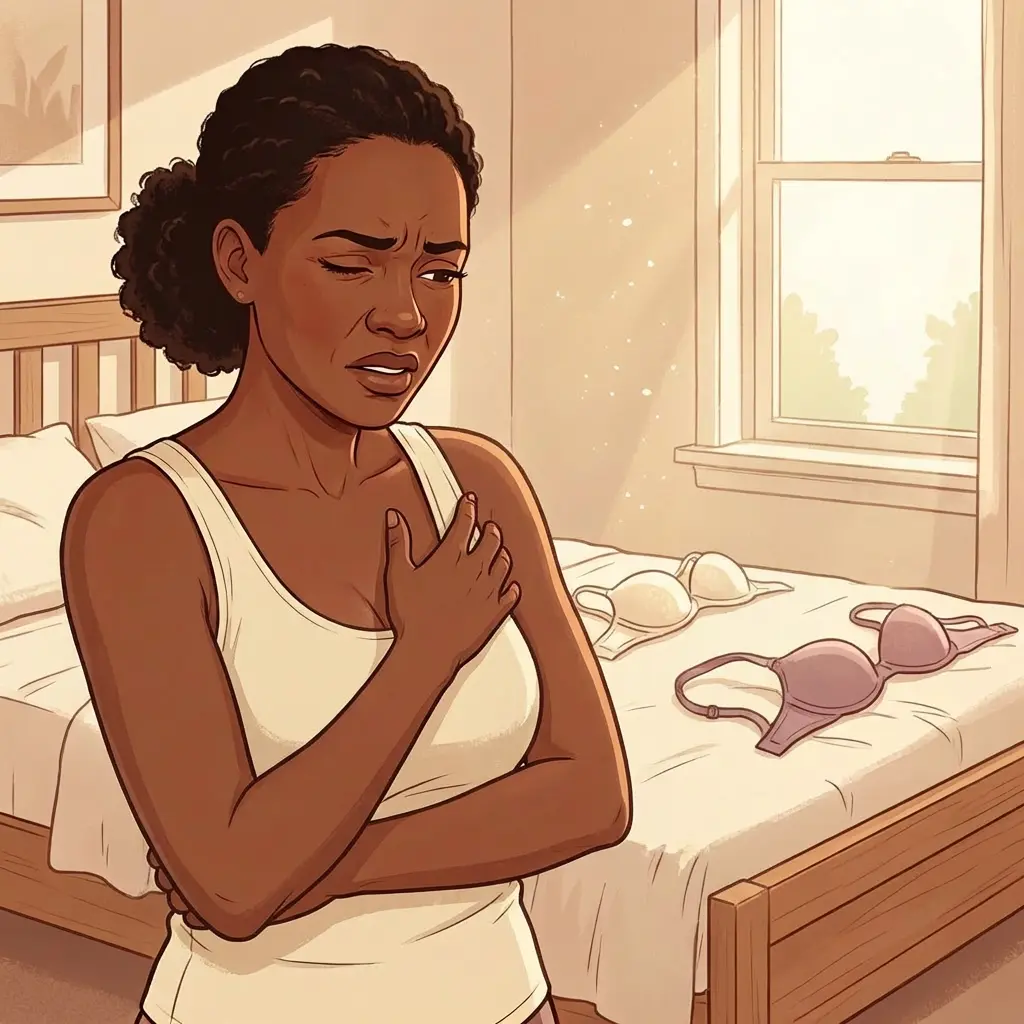

Breast Pain That's Worse Than Any PMS You've Known
Perimenopause breast pain is qualitatively different from the mild tenderness you might have experienced premenstrually in your twenties and thirties. It's more intense, longer-lasting, and sometimes present for weeks rather than days. Women describe it as aching, burning, heavy, or a deep soreness that makes sleeping on your stomach impossible and hugging painful. The sensitivity can be bilateral or one-sided, generalized or focused in specific areas.
The fear component is significant and deserves honest acknowledgment. When breast pain is persistent and intense, the thought 'is this cancer?' is nearly universal. The anxiety compounds the physical discomfort and drives urgent medical visits — which is appropriate. But understanding that hormonal breast pain during perimenopause is extremely common and almost always benign can reduce the fear while you pursue proper evaluation.
Cyclical patterns provide clues. If breast pain worsens before your period and improves after bleeding starts, the hormonal connection is strongly suggested. But during perimenopause, when cycles become irregular, the cyclical pattern can become erratic — pain may last longer, overlap between cycles, or seem randomly timed. This is because estrogen fluctuations during perimenopause are themselves erratic.
Fibrocystic changes — lumpy, rope-like breast tissue — often increase during perimenopause. This is estrogen-driven proliferation of glandular tissue and is benign, but the lumpy texture understandably increases cancer anxiety. Women who experience new lumps or texture changes should have imaging for reassurance, while understanding that fibrocystic changes are the norm during hormonal transitions.
"I couldn't hug my children without wincing. Sleeping on my stomach was impossible. I was convinced something was seriously wrong. It was estrogen dominance — and progesterone resolved it within one cycle."
— Age 43
Estrogen Stimulates Breast Tissue — and Perimenopause Delivers Too Much, Erratically
Breast tissue is among the most estrogen-sensitive tissue in the body. Estrogen drives proliferation of breast ductal and glandular cells, increases fluid retention in breast tissue, and stimulates breast density. During a normal cycle, estrogen peaks at ovulation, stimulates breast tissue, and then progesterone in the luteal phase counterbalances some of that stimulation. When the cycle ends and estrogen drops, breast tenderness resolves.
During perimenopause, this system becomes dysfunctional in two ways. First, estrogen levels can spike dramatically — sometimes higher than normal cycling levels — before crashing. These supraphysiological estrogen spikes create intense breast tissue stimulation. Second, progesterone production declines (because ovulation becomes irregular), removing the counterbalancing effect. The result is estrogen dominance in breast tissue: high stimulation without adequate modulation.
Progesterone's role is specifically important. In normal cycling, progesterone limits estrogen's proliferative effect on breast tissue. When progesterone is low or absent (anovulatory cycles, which become common in perimenopause), estrogen acts unopposed on breast tissue — producing more swelling, more pain, and more fibrocystic changes.
Caffeine sensitivity may increase during perimenopause. Methylxanthines in caffeine can stimulate breast tissue and contribute to cystic changes. Women who never had caffeine-related breast pain may develop it during perimenopause because the tissue is already hormonally sensitized. This doesn't mean caffeine causes breast pain — it means caffeine can compound hormonal breast pain in sensitized tissue.
How It Happens
When to Worry — and When to Treat Hormonally
The question every woman with perimenopause breast pain asks is: could this be cancer? Breast cancer typically presents as a painless lump — not as bilateral aching or cyclical tenderness. However, breast pain CAN occasionally be associated with breast cancer, which is why any new, persistent, or unilateral breast symptom deserves imaging. The point isn't to dismiss breast pain — it's to contextualize it within the overwhelmingly hormonal cause while ensuring appropriate screening.
Risk factors that warrant prompt imaging: pain that is strictly unilateral and persistent (not cyclical), a new palpable lump that doesn't fluctuate with your cycle, skin changes over the breast (dimpling, redness, texture changes), nipple discharge (especially bloody or unilateral), and breast pain that is truly new and doesn't correlate with any other perimenopause symptoms. These warrant mammography and/or ultrasound regardless of hormonal context.
Breast pain that is bilateral, cyclical (even erratically so), accompanied by other perimenopause symptoms, and occurs in the context of changing cycles is overwhelmingly hormonal. This doesn't mean skip screening — regular mammography should continue per guidelines — but it does mean the hormonal root should be addressed directly rather than endured with worry.
Chest wall pain (from the ribs, muscles, or cartilage between ribs) can masquerade as breast pain. This is worth mentioning because musculoskeletal changes also occur during perimenopause — increased inflammation, joint changes, and muscle tension can all produce chest wall pain that feels like breast pain. A simple test: if pressing on the chest wall reproduces the pain, the source may be musculoskeletal rather than breast tissue.
"The fear was worse than the pain. Every ache made me think cancer. My mammogram was clear. My hormones were not. Once we addressed the estrogen-progesterone imbalance, the pain subsided."
— Age 46
Breast Pain + Heavy Periods
Both driven by estrogen dominance. High estrogen stimulates breast tissue AND endometrial lining. Progesterone deficiency is the shared root.
Ask about: Estrogen-progesterone balance evaluation
Breast Pain + Bloating
Estrogen dominance causes fluid retention in breast tissue AND abdominally. Same hormonal mechanism, different tissue expression.
Ask about: Comprehensive hormonal evaluation for estrogen dominance
Breast Pain + Cancer Fear
The anxiety is valid. Appropriate screening provides reassurance while hormonal treatment addresses the pain. Both deserve attention simultaneously.
Ask about: Imaging timeline + hormonal evaluation in parallel
Fibrocystic Changes
Lumpy, ropey breast tissue is estrogen-driven glandular proliferation. Common during perimenopause, benign, but understandably anxiety-producing.
Ask about: Imaging for reassurance + progesterone for treatment
When to See a Provider Promptly
- •Unilateral persistent pain with a new lump — warrants imaging regardless of hormonal context
- •Nipple discharge (especially bloody or one-sided) — seek prompt evaluation
- •Skin changes over the breast (dimpling, redness, texture) — mammography indicated
Reducing the Pain at the Source
Progesterone support is the most targeted intervention for estrogen-dominant breast pain. By counterbalancing estrogen's stimulatory effect on breast tissue, progesterone can reduce swelling, tenderness, and fibrocystic changes. Micronized progesterone in the luteal phase — or continuously if cycles are irregular — is the standard approach.
Evening primrose oil (EPO) has evidence for cyclical breast pain. It provides gamma-linolenic acid (GLA), which modulates prostaglandin pathways involved in breast pain. Dosing is typically 1000-3000mg daily. Effects may take 2-3 months to be noticeable. It's not a first-line hormonal intervention, but it can complement hormonal support.
Caffeine reduction is worth trying for 4-6 weeks to assess impact. Some women experience significant improvement; others notice no change. Given that caffeine sensitivity may be specifically increased during hormonal transitions, a trial reduction is a low-risk experiment with potentially meaningful benefit.
Proper breast support matters more during perimenopause than at any other time. A well-fitted supportive bra (especially during exercise) reduces mechanical pain. Some women find that wearing a soft sleep bra reduces nighttime discomfort. Ice packs for acute flares and anti-inflammatory topicals (diclofenac gel applied to the breast skin) can provide localized relief.
Symptom Tracker — Breast Pain
Track these for 2–4 weeks before your appointment
💾 Save this tracker — bring it to your first appointment
We Address the Hormonal Root While Ensuring the Right Screening
At Pause & Reset, breast pain during perimenopause is evaluated within the full hormonal context. We assess estrogen and progesterone patterns, evaluate for estrogen dominance, and determine whether progesterone support and/or estrogen modulation will address the breast tissue stimulation at its root.
We also ensure that appropriate breast cancer screening is current — not because we think every breast pain is cancer, but because responsible care means ruling out concerning causes while treating the overwhelmingly likely hormonal one. This dual approach — hormonal treatment AND screening confidence — addresses both the pain and the fear.
The goal is reducing breast pain while also addressing the other symptoms of estrogen dominance that typically accompany it: heavy periods, bloating, mood changes, and weight gain. When the hormonal environment is balanced, breast symptoms often improve alongside everything else.