
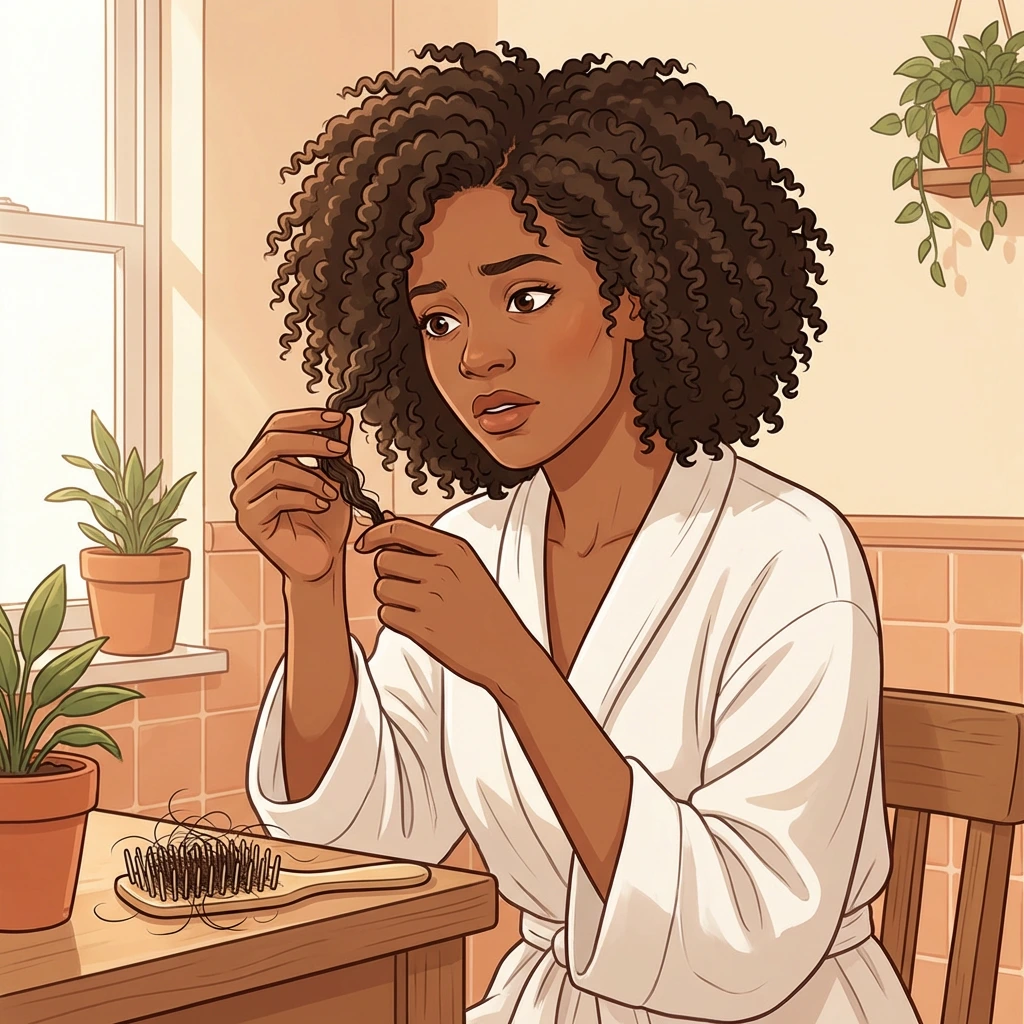

The Changes Are Subtle — Until They're Not
It starts with small things you almost dismiss. More hair in the shower drain than usual. A ponytail that feels thinner between your fingers. A part that seems slightly wider. You tell yourself it's nothing.
Then one day you see it. A photograph taken from an angle you don't usually see yourself from. Or the way your hair lies flat where it used to have volume. Or the scalp visibility that wasn't there six months ago.
Hair thinning hits differently than other perimenopause symptoms because it's visible. Fatigue is invisible. Anxiety is invisible. But your hair is something you see in every mirror, every photo, every reflection. It's tied to identity in a way that other symptoms aren't.
The emotional weight is compounded by confusion. Your doctor may tell you it's just aging. The internet offers a thousand conflicting answers. What women actually need is a clear explanation of why it's happening and a specific plan based on what's driving it.
"I saw a photo of the back of my head at a family event. I didn't recognize my own hair."
— Age 43
The Hormone Shift That Changes Your Hair From the Root
Your hair grows in cycles. Each follicle goes through an active growth phase (anagen), a transition phase (catagen), and a resting/shedding phase (telogen). In your reproductive years, estrogen helps keep more follicles in the growth phase for longer.
During perimenopause, declining estrogen shortens the growth phase and extends the resting phase. Fewer hairs are actively growing at any given time. The hairs that do grow may be finer and shorter.
But estrogen decline is only part of the story. As estrogen and progesterone fall, the relative influence of androgens — including testosterone and DHT — increases. DHT miniaturizes hair follicles, particularly in the crown and frontal areas.
Thyroid hormones also play a critical role. Both hypothyroidism and hyperthyroidism can cause significant hair shedding. Hair loss from thyroid imbalance is typically diffuse — affecting the entire scalp.
How It Happens
Hair Loss Is a Symptom With Many Possible Roots
Hormonal shifts during perimenopause are the most common driver of hair thinning in women in their 40s and 50s, but they're not the only possibility.
Iron and ferritin deficiency is one of the most underappreciated causes. Ferritin can be low enough to cause hair shedding well before you'd be flagged as anemic. Many practitioners aim for a ferritin level of at least 70 to 80 ng/mL for optimal hair growth.
Vitamin D deficiency is associated with hair follicle cycling abnormalities. Vitamin D receptors are present on hair follicles, and inadequate levels may impair the growth phase.
Stress-induced shedding (telogen effluvium) can be triggered by significant physical or emotional stress. It typically produces diffuse hair shedding two to four months after the triggering event.
Autoimmune conditions including alopecia areata can present during perimenopause. Patchy hair loss with smooth, circular bald spots has a different mechanism.
Nutritional deficiencies beyond iron — including zinc, biotin, omega-3 fatty acids, and protein — can contribute to poor hair quality.
"My ponytail used to take three wraps with the elastic. Now it takes five. That might sound small, but it's not."
— Age 46
Thyroid Dysfunction
Both hypo- and hyperthyroidism cause diffuse hair thinning that can be hard to distinguish from hormonal hair loss.
Ask about: Full thyroid panel with antibodies
Iron / Ferritin Deficiency
Ferritin below 70 ng/mL is associated with hair thinning — even when it's technically in "normal" range.
Ask about: Ferritin (aim 70-80+ ng/mL), iron panel, CBC
Autoimmune Conditions
Alopecia areata and other autoimmune conditions can emerge or worsen during hormonal transitions.
Ask about: ANA, thyroid antibodies, dermatology referral if patchy
When to See a Provider Promptly
- •Hair loss is sudden or patchy
- •Accompanied by scalp pain, redness, or scarring
Details That Point Your Provider in the Right Direction
Document the pattern. Where is the thinning most noticeable — crown, temples, part line, all over? Take photos in consistent lighting every two to four weeks.
Note the timeline. When did you first notice changes? Was it gradual or sudden? Did anything correlate with the onset?
Estimate how much hair you're losing. Some shedding is normal (50-100 hairs per day). More than that, consistently, is worth investigating.
Gather your recent lab work if you have it. Thyroid, CBC, iron/ferritin, vitamin D.
List your hair care routine. Heat styling frequency, chemical treatments, coloring, tight hairstyles. Some practices contribute to mechanical damage that compounds hormonal thinning.
Symptom Tracker — Perimenopause Hair Thinning
Track these for 2–4 weeks before your appointment
💾 Save this tracker — bring it to your first appointment
We Treat Hair Loss From the Inside Out
At Pause & Reset, we understand that hair thinning during perimenopause isn't a cosmetic issue — it's a clinical one. Your hair is responding to internal changes, and the solution starts with identifying exactly which changes are driving it.
Our approach starts with a comprehensive evaluation. We assess your full hormone panel (estrogen, progesterone, testosterone, DHEA-S, DHT), thyroid function including antibodies, iron studies with ferritin, vitamin D, inflammatory markers, and metabolic indicators.
Dr. Nina brings a unique perspective here, with deep expertise in both hormone wellness and trichology — the science of hair and scalp health. We don't just address the hormone side or the hair side — we connect both.
The most important thing we want you to know: early intervention matters. Hair follicles that have been miniaturized for years are harder to recover than those caught early in the thinning process.