
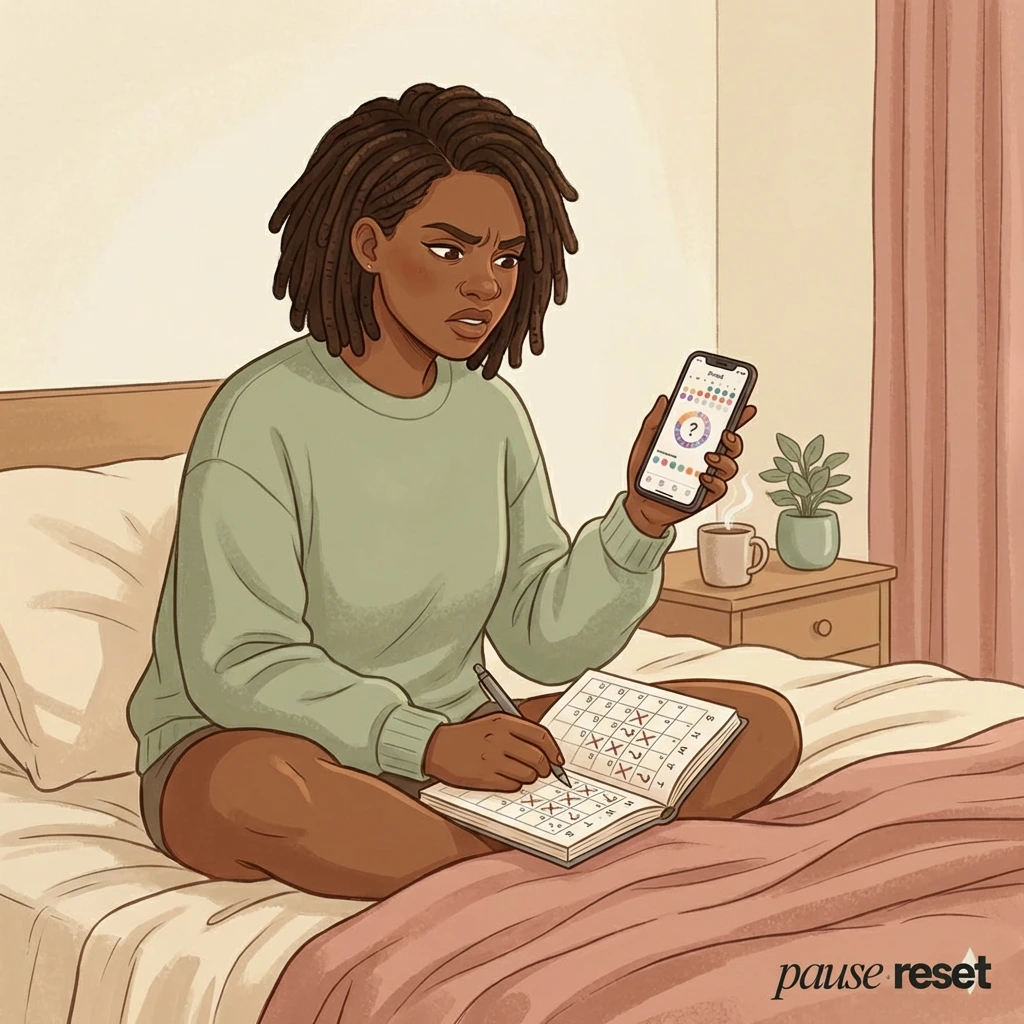
What's Actually Happening to Your Cycle
Your menstrual cycle is a hormone-driven conversation between your brain, your ovaries, and your uterus. Each month, FSH (follicle stimulating hormone) prompts an egg to develop, estrogen rises as the follicle matures, ovulation releases the egg, the corpus luteum produces progesterone, and if pregnancy doesn't occur, both hormones drop and your period begins. This cycle has been running on a roughly 28-day loop since puberty.
During perimenopause, the conversation gets noisy. Your ovarian reserve is declining — fewer follicles are available to respond to FSH. Your brain compensates by increasing FSH levels, sometimes dramatically, which can stimulate more estrogen production than usual. Meanwhile, ovulation becomes less reliable — some cycles you ovulate normally, some you ovulate late, and some you don't ovulate at all (anovulatory cycles). When you don't ovulate, you don't produce progesterone from the corpus luteum. Without progesterone to stabilize the uterine lining, it grows unchecked under estrogen's influence and eventually sheds unpredictably.
This is why perimenopause periods can be so chaotic. A cycle where you ovulated early might be short (21-24 days). A cycle where you ovulated late might be long (35-45 days). A cycle where you didn't ovulate at all might be followed by extremely heavy bleeding as the thickened lining finally sheds. The pattern can change from month to month with no consistency — and that unpredictability is itself a hallmark of the hormonal instability defining perimenopause.
Heavier periods deserve specific attention. Without adequate progesterone to counterbalance estrogen, the endometrial lining can grow thicker than normal before shedding — producing flooding, clotting, and prolonged bleeding. Many women in perimenopause experience their heaviest periods ever during this transition. This isn't just inconvenient — it's a significant cause of iron depletion, which drives fatigue, hair thinning, and cognitive changes.
"My periods went from 28 days like clockwork to completely random. 22 days, then 45, then flooding for a week. Nobody told me this was perimenopause — I thought something was seriously wrong."
— Age 43
Why Each Type of Cycle Change Means Something Different
Shorter cycles (under 25 days) in early perimenopause typically indicate that the follicular phase — the first half of your cycle — is shortening. Your body is recruiting and maturing eggs faster because the declining ovarian reserve means FSH has to work harder. You're still ovulating, but the process is accelerated. This is often the earliest detectable cycle change and can begin in the late thirties.
Longer cycles (over 35 days) usually signal that ovulation is delayed or absent. The follicular phase extends because it takes longer for a follicle to mature and trigger ovulation — or because no follicle matures sufficiently that cycle. Longer cycles become more common as perimenopause progresses and are a later-stage sign compared to cycle shortening.
Heavier and longer bleeding episodes reflect the progesterone deficit. In a normal cycle, progesterone stabilizes the endometrial lining and produces a controlled, time-limited bleed when it withdraws. Without adequate progesterone — because ovulation didn't occur or the corpus luteum underperformed — the lining grows under unopposed estrogen stimulation and eventually breaks down irregularly, producing heavier, longer, and more unpredictable bleeding.
Skipped periods can mean ovulation simply didn't happen that cycle. The absence of a period isn't necessarily a sign that menopause is imminent — periods can return the following month. In perimenopause, cycle-to-cycle variability is the norm. The medical definition of reaching menopause requires twelve consecutive months without a period — which means that skipping one, two, or even several months followed by resumption is still perimenopause, not menopause.
How It Happens
When Cycle Changes Need Evaluation — Not Just Tracking
Not every irregular period during perimenopause requires intervention — some variability is expected. But certain patterns warrant evaluation to rule out causes that need specific treatment and to address the health consequences of significant cycle disruption.
Heavy bleeding that soaks through a pad or tampon every hour for several consecutive hours, requires double protection (pad plus tampon), includes large clots (larger than a quarter), or lasts more than seven days needs evaluation. This level of bleeding can cause significant iron depletion and may indicate endometrial hyperplasia (overgrowth of the uterine lining) that should be assessed. Endometrial evaluation — often via transvaginal ultrasound — can assess lining thickness and rule out structural causes like fibroids or polyps.
Bleeding between periods (intermenstrual bleeding), bleeding after intercourse, or any bleeding after you've gone several months without a period should be evaluated. These patterns don't always indicate something serious, but they warrant assessment to rule out endometrial pathology.
Iron status should be checked in any woman with heavier-than-usual perimenopause periods. Ferritin can drop silently — you won't show up as anemic on a standard CBC until iron stores are severely depleted. But functional iron deficiency at ferritin levels of 20 to 50 ng/mL (which most labs call 'normal') can produce fatigue, brain fog, hair thinning, and exercise intolerance. The connection between heavy periods, falling ferritin, and worsening perimenopause symptoms is one of the most commonly missed clinical patterns.
"I was changing a super tampon every hour and my doctor just said 'some periods are heavy.' Dr. Nina found my ferritin was 12 and my progesterone was nonexistent. Treatment changed everything."
— Age 41
Tracking Your Cycle Through the Transition
Cycle tracking during perimenopause isn't about predicting your period with precision — it's about recognizing patterns that inform clinical decisions. A simple period tracking app or even a calendar notation of start dates, duration, and flow intensity provides valuable data over several months.
Note cycle length (first day of one period to first day of the next), number of bleeding days, flow intensity (light, moderate, heavy, flooding), clots (size and frequency), spotting between periods, and any symptoms that correlate with specific cycle phases (PMS worsening, mid-cycle pain, premenstrual mood changes). Three to six months of this data gives your provider a clear picture of your cycle's current behavior.
If periods are very heavy, track your protection use — how many pads, tampons, or cups per day, and how often you're changing them. This quantifies blood loss in a way that's clinically useful and helps determine whether iron assessment is urgent.
Cycle tracking data combined with timed lab work (progesterone on day 21, estradiol at baseline) creates the most complete picture of what's happening hormonally. This is the foundation for deciding whether progesterone support, further endometrial evaluation, or other interventions are appropriate.
We Take Cycle Changes Seriously — As Data, Not Just Inconvenience
At Pause & Reset, we treat menstrual cycle changes during perimenopause as clinical information — not something to just live with until periods eventually stop. Your cycle is giving you real-time data about your hormonal environment, and interpreting that data correctly informs every other aspect of your perimenopause care.
Dr. Nina evaluates cycle changes in context: what your periods are doing, what your hormones show on timed lab work, what your endometrial lining looks like when imaging is warranted, and what symptoms are clustering alongside the cycle disruption. Heavy bleeding gets iron assessment. Anovulatory patterns get progesterone evaluation. Irregular timing gets the full hormonal and thyroid workup to ensure nothing else is contributing.
For women whose primary complaint is cycle disruption, progesterone support often restores predictability and reduces the heavy, unpredictable bleeding that unopposed estrogen produces. For women with structural contributors (fibroids, polyps), appropriate imaging and referral ensure those are addressed. For women whose irregular periods are their first clue that perimenopause has begun, the evaluation opens the door to comprehensive care that addresses everything the transition is producing — not just the bleeding.
Your period changing isn't just an inconvenience to manage. It's your body's earliest and most visible signal that the hormonal transition is underway. Listening to that signal — and acting on it — is one of the smartest things you can do for your health.