
What Estrogen Dominance Actually Means (Not What You Think)
Estrogen dominance doesn't necessarily mean your estrogen is too high in absolute terms. It means your estrogen is too high relative to your progesterone. The ratio between these two hormones matters as much as their individual levels — and during early perimenopause, that ratio shifts dramatically because progesterone typically declines first while estrogen can remain normal or even spike to higher-than-usual levels.
Think of it this way: estrogen is the accelerator and progesterone is the brake. When both are at healthy levels, they balance each other — estrogen stimulates growth and activity, progesterone calms and regulates. When progesterone drops first (as it commonly does in early perimenopause), the brake weakens while the accelerator stays floored. Even 'normal' estrogen levels become functionally excessive without adequate progesterone counterbalance.
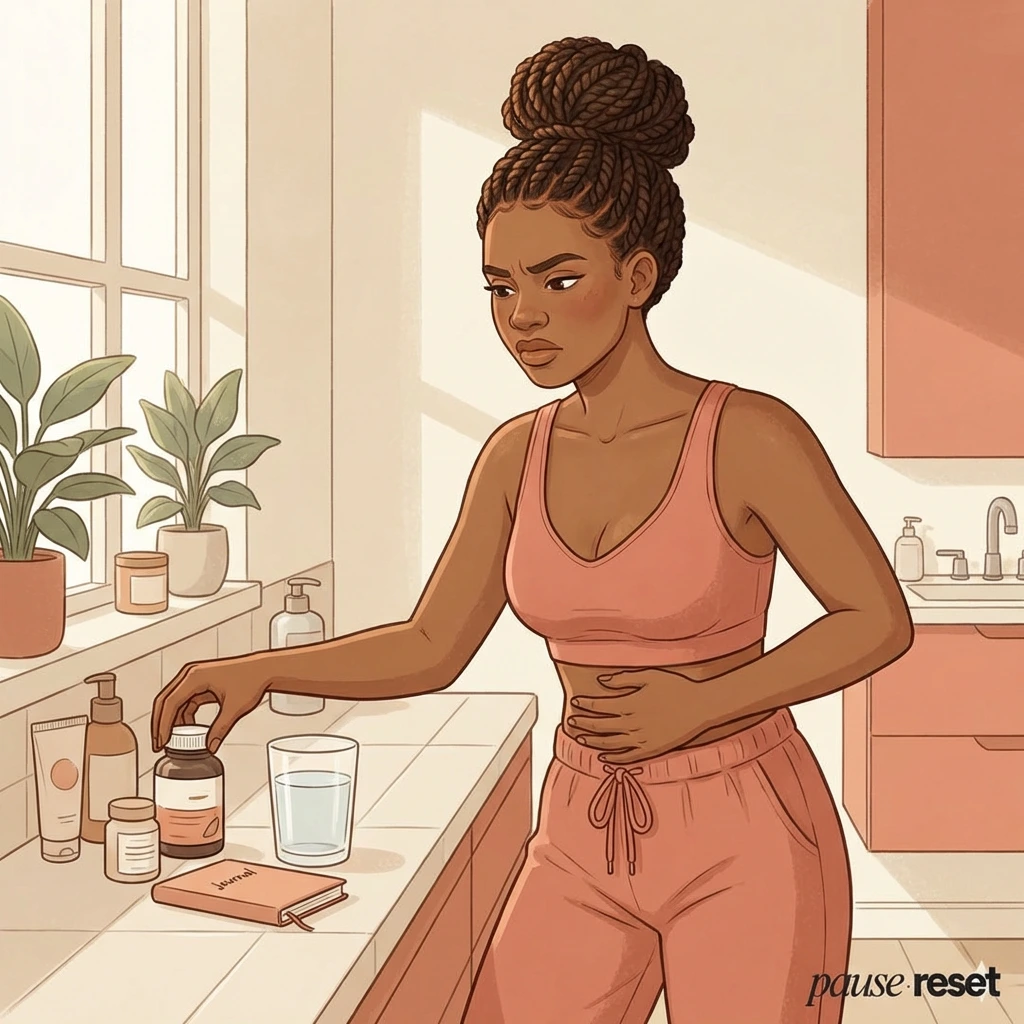
This imbalance produces a specific symptom cluster that many women recognize: heavy periods, breast tenderness, bloating and water retention, irritability and mood swings, weight gain (especially around hips and thighs initially), sleep disruption, headaches (particularly premenstrual), and worsening PMS. These symptoms often intensify in the second half of the menstrual cycle — the luteal phase — when progesterone should be at its peak but isn't.
The term 'estrogen dominance' is controversial in conventional medicine, partly because it has been oversimplified and sometimes misused in wellness marketing. But the underlying concept — that the estrogen-to-progesterone ratio matters clinically and that relative progesterone insufficiency produces measurable symptoms — is well-supported by endocrine physiology. What matters isn't the label. What matters is recognizing the pattern and addressing it.
"My estrogen was 'normal.' My progesterone was in the basement. Nobody looked at the ratio until Dr. Nina. Two weeks on progesterone and my PMS symptoms cut in half."
— Age 40
The Biochemistry Behind the Imbalance
During the normal menstrual cycle, estrogen and progesterone rise and fall in a coordinated pattern. Estrogen dominates the first half (follicular phase), promoting endometrial growth. Progesterone dominates the second half (luteal phase), stabilizing the lining, calming the nervous system, and preparing for potential pregnancy. The balance between these two hormones during the luteal phase determines how you feel in the two weeks before your period.
In early perimenopause, ovulation can become less robust. Even when ovulation occurs, the corpus luteum (the structure that forms after egg release and produces progesterone) may produce less progesterone for a shorter time. A luteal phase progesterone level of 15 to 25 ng/mL is considered optimal. Many early perimenopausal women test at 5 to 10 ng/mL — technically 'not absent' but functionally insufficient to counterbalance estrogen's effects.
Meanwhile, estrogen can actually increase during early perimenopause. As the ovarian reserve declines, FSH rises to compensate, sometimes stimulating higher-than-normal estrogen production before the follicular reserve is truly depleted. This creates the paradox of perimenopause: you can have elevated estrogen AND declining progesterone simultaneously. The ratio inverts, and the symptoms of that inversion are what gets labeled 'estrogen dominance.'
The estrobolome — the subset of gut bacteria that metabolizes estrogen — also plays a role. If your gut microbiome isn't efficiently processing and clearing estrogen, recycled estrogen re-enters circulation, adding to the relative excess. This is one reason gut health becomes clinically relevant during perimenopause and why the hormone-gut connection matters.
How It Happens
Recognizing the Pattern in Your Own Body
Estrogen dominance patterns are most common in women in their late thirties to mid-forties — the early perimenopause window when progesterone has begun declining but estrogen is still present or elevated. If you're experiencing a cluster of the following symptoms, particularly if they worsen in the second half of your cycle, the estrogen-progesterone ratio is worth investigating.
The hallmark symptoms include: significantly worsened PMS (mood, bloating, breast tenderness, headaches), periods that have become heavier with more clotting, water retention and puffiness that fluctuates with your cycle, weight gain especially in the hips, thighs, and lower abdomen, irritability and emotional volatility concentrated in the luteal phase, sleep disruption particularly in the week before your period, and breast pain or fibrocystic changes.
Women who have been told 'your estrogen is normal' based on a single lab draw may actually be in this pattern. Estrogen can be 'normal' or even high while the ratio to progesterone is inverted. A single estradiol level without a corresponding luteal-phase progesterone level tells an incomplete story. The ratio — not the individual number — is what drives the symptoms.
This pattern is also relevant for women exposed to environmental estrogens (xenoestrogens) through plastics, pesticides, personal care products, and processed foods. While environmental exposure is a smaller factor than ovarian hormone changes, it can add to the estrogenic load that an already-depleted progesterone level can't counterbalance.
"I had every symptom on the estrogen dominance list and my conventional doctor told me it wasn't a real thing. Turns out the thing that 'isn't real' was completely treatable."
— Age 38
How to Evaluate and Address Estrogen Dominance
Evaluation starts with timed lab work. Estradiol can be tested at any point in your cycle for a baseline, but the critical test is luteal-phase progesterone — drawn between days 19 and 22 of your cycle, when progesterone should be at its peak. If progesterone is low relative to estrogen, the pattern is confirmed. DUTCH testing (dried urine comprehensive hormones) adds another layer by showing how your body is metabolizing estrogen — through favorable pathways (2-OH) or less favorable pathways (4-OH, 16-OH) — which has implications for both symptom management and long-term risk.
The primary treatment for estrogen dominance during perimenopause is restoring progesterone. Bioidentical micronized progesterone — taken during the luteal phase or continuously, depending on your cycle status — directly corrects the ratio imbalance. Many women notice improvement in sleep, mood, breast tenderness, and PMS within the first cycle. Heavy periods typically improve within two to three cycles as progesterone stabilizes the endometrial lining.
Supporting healthy estrogen metabolism is the complementary strategy. This includes optimizing gut health (so the estrobolome efficiently clears estrogen), ensuring adequate fiber intake (fiber binds estrogen in the GI tract for elimination), supporting liver detoxification pathways (cruciferous vegetables, B vitamins, magnesium), reducing xenoestrogen exposure (switching to glass food containers, clean personal care products), and managing stress (cortisol competes with progesterone for precursor hormones).
The combination of progesterone restoration and estrogen metabolism support addresses the imbalance from both directions — adding what's missing and helping clear what's in relative excess.
We See Past the Controversy to the Clinical Reality
At Pause & Reset, we don't use 'estrogen dominance' as a marketing buzzword and we don't dismiss it as pseudoscience. We recognize it as a real, measurable hormonal pattern — the relative excess of estrogen to progesterone that defines early perimenopause for many women — and we evaluate and treat it with the same clinical rigor we apply to every other aspect of hormonal health.
Dr. Nina tests both estradiol and luteal-phase progesterone, interprets them as a ratio, and combines lab data with your symptom pattern to determine whether the estrogen-progesterone balance is driving your presentation. When it is, treatment is straightforward and often dramatically effective: bioidentical progesterone restores the balance, and estrogen metabolism support ensures your body is processing hormones efficiently.
We also address what conventional medicine often ignores in this conversation: the gut health, liver function, stress, and environmental factors that influence how your body handles estrogen. This is where functional medicine and hormone health intersect — and where the most complete solutions live.
If you've read about estrogen dominance online and aren't sure what's real, what's marketing, and what's relevant to your situation — we can give you a clear, evidence-based answer based on your actual labs, not internet speculation.