
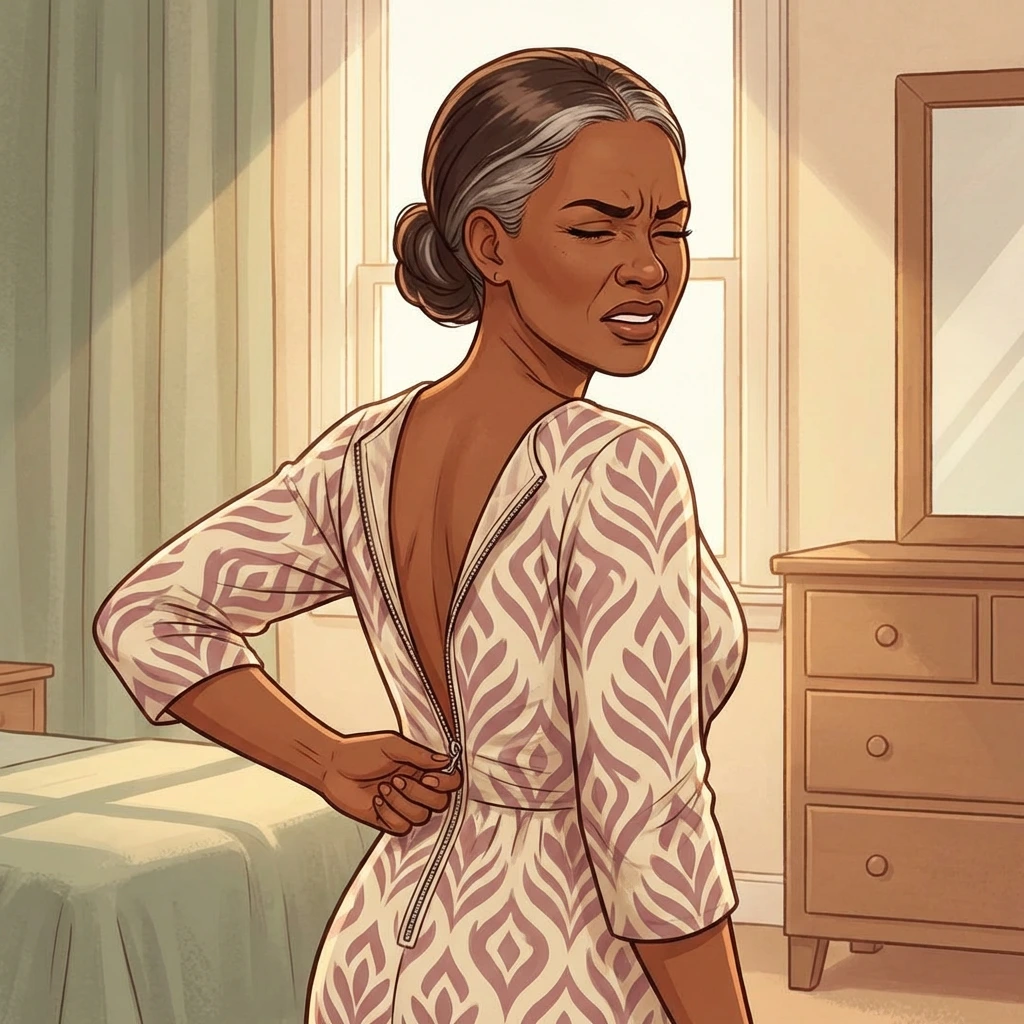

The Shoulder That Locked Up Without Warning
It starts subtly — a tightness when you reach for something on a high shelf, a twinge when you try to clasp your bra behind your back. Within weeks or months, the limitation becomes undeniable. You can't lift your arm overhead. Reaching behind your back is impossible. Sleeping on that side wakes you in pain. Getting dressed becomes a strategic operation. And the kicker — for many women, the other shoulder follows within a year or two.
The orthopedist diagnoses adhesive capsulitis — frozen shoulder — and offers cortisone injections and physical therapy. Both can help with symptom management. But nobody connects the timing to your hormonal transition. Nobody asks about your menstrual cycle, your sleep, your hot flashes, or the other joint stiffness that might be creeping in elsewhere. The shoulder gets treated as an isolated orthopedic event when it's actually a signal from your hormonal environment.
The emotional toll compounds the physical. Losing range of motion in your shoulder affects everything from exercise to driving to hugging your kids. For women already navigating the psychological weight of perimenopause, losing physical capability feels like one more thing being taken away. And the recovery timeline — often 12 to 24 months for full resolution — feels impossibly long when nobody is addressing why it happened in the first place.
Women who've had frozen shoulder during perimenopause often say the same thing: 'If someone had told me this was hormonal, I would have felt less crazy.' You're not crazy. Your shoulder is responding to the same hormonal environment that's producing your other symptoms. And understanding that connection changes both the treatment and the prognosis.
"My orthopedist said it was just bad luck. Two cortisone shots later, still frozen. When Dr. Nina checked my hormones, my estrogen was in the basement. Six months of HRT and PT together — my shoulder came back."
— Age 48
Estrogen Receptors in the Shoulder Capsule — The Missing Link
Research has confirmed the presence of estrogen receptors in the shoulder joint capsule, synovial tissue, and surrounding connective structures. Estrogen regulates collagen synthesis, turnover, and remodeling in these tissues. It also modulates the inflammatory response within the joint. When estrogen declines during perimenopause, several cascading effects occur in the shoulder capsule.
First, collagen turnover becomes dysregulated. Instead of the normal cycle of breakdown and rebuilding, the capsule begins to thicken with disorganized fibrotic tissue. This fibrosis stiffens the capsule progressively. Second, inflammatory cytokines increase in the joint space — producing the pain and swelling that accompany the stiffness. Third, the capsule begins to adhere to itself and to the humeral head, progressively restricting range of motion in a characteristic pattern: external rotation lost first, then abduction, then flexion.
The peak incidence of frozen shoulder in women between 40 and 60 maps directly onto the menopausal transition. Studies have shown that women with frozen shoulder are significantly more likely to have markers of estrogen decline and metabolic dysfunction compared to age-matched controls. Diabetes — which becomes more prevalent during menopause due to insulin resistance — is an independent risk factor that compounds the hormonal mechanism.
This is the same collagen and inflammation pathway that produces joint pain throughout the body during perimenopause. Frozen shoulder is the extreme version — concentrated in a uniquely vulnerable joint capsule. If your shoulder froze at 47, your other joints are almost certainly experiencing lower-grade versions of the same hormonal collagen disruption.
How It Happens
Your Shoulder Is a Window Into Systemic Inflammation
Frozen shoulder during perimenopause is best understood as a localized expression of a systemic hormonal and inflammatory shift. The same collagen dysregulation and inflammation affecting your shoulder capsule is likely affecting your other joints, your tendons, and your connective tissue throughout your body. Women with frozen shoulder frequently report concurrent joint stiffness in their hands, knees, or hips — even if those joints haven't progressed to full restriction.
Thyroid dysfunction deserves specific attention. Hypothyroidism — which frequently surfaces during perimenopause — is independently associated with frozen shoulder. The mechanism is separate from the estrogen pathway: thyroid hormones directly influence connective tissue metabolism. If you have frozen shoulder AND fatigue, cold intolerance, weight gain, and brain fog, a full thyroid panel (not just TSH) is essential.
Metabolic syndrome and insulin resistance add another layer. Diabetes is the single strongest independent risk factor for frozen shoulder, and insulin resistance is increasingly common during the menopausal transition. The metabolic and hormonal factors don't just coexist — they amplify each other. Addressing the metabolic picture alongside the hormonal picture produces better outcomes than treating either alone.
The point is clear: frozen shoulder isn't an orthopedic accident. It's metabolic and hormonal data delivered through your shoulder joint. A comprehensive evaluation that includes hormonal, thyroid, and metabolic assessment provides the full picture — and opens treatment pathways that cortisone injections alone can't access.
"First my right shoulder froze, then my left a year later. Nobody connected it to menopause until I found Pause & Reset. The same estrogen decline was driving both."
— Age 50
Bilateral Frozen Shoulder
Both shoulders — strongly suggests a systemic hormonal driver rather than local injury.
Ask about: Full hormonal panel + thyroid + metabolic markers
Joint Pain Beyond the Shoulder
Hands, knees, hips also stiff? The same collagen disruption is affecting your whole system.
Ask about: Comprehensive evaluation of hormonal + inflammatory environment
Thyroid Connection
Hypothyroidism is independently associated with frozen shoulder and commonly surfaces during perimenopause.
Ask about: Full thyroid panel with antibodies
Diabetes / Insulin Resistance
The strongest independent risk factor for frozen shoulder — and insulin resistance increases during menopause.
Ask about: Fasting insulin, HbA1c, glucose assessment
When to See a Provider Promptly
- •Shoulder pain after injury or fall — evaluate for rotator cuff tear or fracture
- •Shoulder pain with arm weakness or numbness — neurological evaluation needed
- •Sudden severe shoulder pain with shortness of breath — rule out cardiac event
Beyond Cortisone — Addressing the Root While Managing the Shoulder
Physical therapy remains essential for maintaining and restoring range of motion. Gentle, consistent stretching — not aggressive manipulation — is the evidence-based approach. Pendulum exercises, wall walks, cross-body stretches, and external rotation stretches form the foundation. Consistency matters more than intensity. The capsule needs sustained gentle lengthening over time.
Addressing the hormonal environment can accelerate recovery and prevent recurrence. Research has associated hormone therapy with reduced frozen shoulder incidence. Estrogen's role in collagen regulation and inflammation modulation directly supports the healing process. For women with other perimenopause symptoms alongside frozen shoulder, hormonal optimization serves double duty.
Anti-inflammatory nutrition supports the process from the inside. Omega-3 fatty acids, turmeric/curcumin, and an overall anti-inflammatory dietary pattern can modulate the inflammatory component of adhesive capsulitis. Adequate protein provides the amino acids needed for collagen repair. Vitamin D (commonly deficient during perimenopause) plays a role in both immune regulation and connective tissue health.
When conservative management isn't sufficient, procedures like hydrodilatation (expanding the capsule with fluid), manipulation under anesthesia, or arthroscopic capsular release may be indicated. But even with procedural intervention, addressing the hormonal and metabolic environment that caused the freezing reduces the risk of recurrence — particularly in the opposite shoulder.
Symptom Tracker — Frozen Shoulder
Track these for 2–4 weeks before your appointment
💾 Save this tracker — bring it to your first appointment
We Evaluate the System, Not Just the Joint
At Pause & Reset, frozen shoulder isn't treated as an isolated orthopedic complaint. Dr. Nina evaluates the full hormonal, thyroid, and metabolic picture — because the shoulder is telling us something about the internal environment. If your shoulder froze at 47, we want to know what your estrogen, progesterone, thyroid hormones, insulin, and inflammatory markers look like.
This evaluation doesn't replace orthopedic care — it complements it. Physical therapy addresses the mechanical restriction. Hormonal optimization addresses the environment that created the restriction. Together, they produce faster recovery and lower recurrence risk than either approach alone.
For women with bilateral frozen shoulder (or a history of one shoulder followed by the other), the hormonal connection is even more compelling. Bilateral presentation strongly suggests a systemic driver rather than a local injury. The comprehensive evaluation identifies and addresses that systemic driver.
If you've been told you have 'bad luck' with your shoulder, or that frozen shoulder 'just happens' to women in their forties — it's not luck and it's not random. It's a hormonal signal. And the evaluation you need goes beyond the orthopedist's office.