
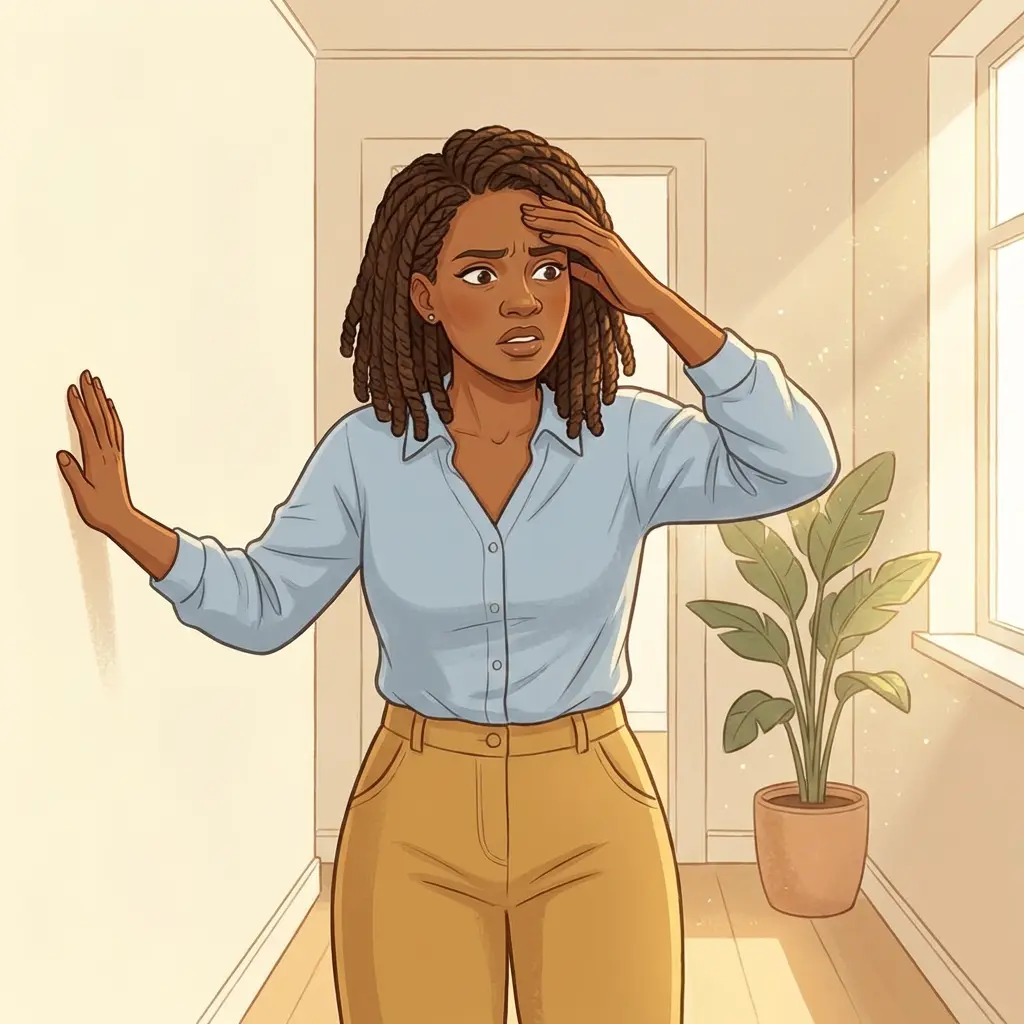

The World Tilts — and Nobody Can Tell You Why
Perimenopause dizziness presents in several forms. Lightheadedness — that woozy feeling when you stand up too quickly, except now it happens when you stand up at normal speed. True vertigo — the room spinning, objects moving when they're not, a sensation that you're tilting even when you're standing still. Imbalance — feeling unsteady on your feet, like the ground isn't quite where it should be. And a diffuse 'off' feeling — not spinning, not lightheaded, just... wrong. All of these can occur during perimenopause.
The diagnostic journey is often exhausting and expensive. Women see ENTs who test for benign paroxysmal positional vertigo (BPPV) and vestibular neuritis — sometimes finding mild findings, sometimes finding nothing. Neurologists rule out central causes with MRIs. Cardiologists check for arrhythmias and orthostatic hypotension. Each specialist finds nothing alarming in their domain — because the root isn't in their domain. It's hormonal.
The anxiety dizziness creates is significant and self-reinforcing. Feeling unsteady triggers hypervigilance about balance, which increases muscle tension and shallow breathing, which worsens the dizzy sensation. Women restrict activities — avoiding driving, exercise, even walking in open spaces — because the unpredictability of dizziness makes everything feel risky. Quality of life contracts significantly.
Timing patterns can provide clues. Dizziness that worsens premenstrually or mid-cycle (when estrogen shifts most dramatically), dizziness that accompanies hot flashes, and dizziness that appeared or worsened in your forties alongside other perimenopause symptoms all point toward the hormonal connection.
"The room would spin when I rolled over in bed. The ENT said it might be crystals in my ear. Three treatments later, no improvement. It was estrogen affecting my vestibular system — nobody checked."
— Age 44
Estrogen, Your Inner Ear, and Your Blood Pressure — All Connected
Estrogen receptors exist in the vestibular system of the inner ear — the structure responsible for balance and spatial orientation. Estrogen influences the fluid dynamics within the semicircular canals and the firing patterns of vestibular neurons. When estrogen fluctuates wildly during perimenopause, the vestibular system can become destabilized, producing vertigo, imbalance, or a sense that spatial orientation is 'off.'
Blood pressure regulation is estrogen-sensitive. Estrogen helps maintain vascular tone and the baroreceptor reflex — the system that adjusts blood pressure when you change positions (like standing up). As estrogen becomes erratic, this reflex can become sluggish, producing orthostatic lightheadedness: dizziness when standing that wasn't an issue before perimenopause.
The autonomic nervous system — which regulates both blood pressure AND vestibular processing — is broadly affected by hormonal changes. Autonomic instability during perimenopause explains why dizziness often co-occurs with heart palpitations, hot flashes, and anxiety: these are all autonomic phenomena driven by the same hormonal destabilization.
Blood sugar instability contributes independently. When insulin sensitivity changes during perimenopause (as it commonly does), blood sugar crashes can produce lightheadedness and dizziness. Women who notice dizziness worsens when hungry, after high-carbohydrate meals, or during long gaps between eating may be experiencing a metabolic component alongside the hormonal one.
How It Happens
Dizziness as Part of Autonomic Instability
The overlap between perimenopause dizziness and other symptoms reveals the shared autonomic root. Heart palpitations (autonomic cardiac regulation), hot flashes (autonomic thermoregulation), anxiety (autonomic fight-or-flight), and dizziness (autonomic blood pressure and vestibular regulation) are all manifestations of the same system being destabilized by hormonal changes. If you have two or more of these, the pattern is diagnostic.
Migraines and dizziness share pathways — vestibular migraine (migraine that presents primarily as dizziness rather than headache) is increasingly recognized and may be triggered by the same estrogen withdrawal mechanism that drives hormonal headaches. If your dizziness is episodic and accompanied by light/sound sensitivity, this possibility is worth evaluating.
Iron deficiency from heavy perimenopause periods can cause dizziness through reduced oxygen delivery to the brain. Thyroid dysfunction affects both vestibular function and blood pressure. Dehydration — especially when hot flashes and night sweats increase fluid loss — lowers blood volume and triggers lightheadedness. The comprehensive evaluation considers all contributors.
The fear component matters medically. Persistent dizziness anxiety can lead to hyperventilation patterns (chronic shallow breathing that changes blood CO2 levels, worsening dizziness), activity avoidance (which deconditions the vestibular system further), and social withdrawal. Addressing the hormonal root often breaks the entire cycle.
"I stopped driving on highways because I was so afraid of a dizzy spell. I saw three specialists. None of them asked about my cycle or my hormones. I spent $4,000 on tests before getting the real answer."
— Age 47
Dizziness + Heart Palpitations
Both driven by autonomic nervous system instability. Same hormonal root, different organ system expression.
Ask about: Comprehensive autonomic and hormonal evaluation
Dizziness + Hot Flashes
Hot flashes are autonomic thermoregulatory events. Dizziness can co-occur through shared hypothalamic destabilization.
Ask about: Combined vasomotor and vestibular assessment
Dizziness + Anxiety
Bidirectional: anxiety worsens dizziness through autonomic activation; dizziness triggers anxiety about falling. Breaking the cycle requires addressing both.
Ask about: Hormonal evaluation + vestibular rehabilitation if needed
Vestibular Migraine
Migraine presenting as dizziness rather than headache — triggered by estrogen withdrawal. Increasingly recognized in perimenopause.
Ask about: Headache/migraine history + hormonal evaluation
When to See a Provider Promptly
- •Sudden severe vertigo with hearing loss — seek emergency ENT evaluation
- •Dizziness with facial droop, weakness, or speech changes — call 911 (stroke symptoms)
- •Fainting or near-fainting with dizziness — cardiac evaluation warranted
Stabilizing the System That Lost Its Anchor
Rule out non-hormonal causes first — or simultaneously. BPPV is common and treatable with the Epley maneuver. Cardiac arrhythmias should be evaluated if palpitations accompany dizziness. Blood pressure monitoring (including orthostatic measurements) identifies blood pressure contributions. Iron studies and thyroid testing are essential baselines.
Hormonal stabilization addresses the root for estrogen-driven dizziness. Stabilizing the estrogen environment can improve vestibular function, normalize blood pressure regulation, and reduce autonomic instability. Many women report dizziness improving as one of the earlier responders to hormonal optimization — sometimes within weeks.
Blood sugar stabilization matters: regular meal timing, protein at every meal, avoiding long fasting windows, and limiting simple carbohydrates that cause glucose spikes and crashes. If dizziness correlates with eating patterns, this is low-hanging fruit that can provide immediate improvement.
Vestibular rehabilitation exercises — simple balance-training movements prescribed by physical therapists — can retrain the vestibular system and reduce dizziness sensitivity regardless of the underlying cause. Staying physically active (rather than avoiding movement out of dizziness fear) is essential because the vestibular system requires movement input to calibrate properly.
Symptom Tracker — Dizziness & Vertigo
Track these for 2–4 weeks before your appointment
💾 Save this tracker — bring it to your first appointment
We Connect the Dizziness to the Hormonal Picture
At Pause & Reset, dizziness evaluation begins with the question most specialists skip: what else changed when the dizziness started? If it arrived alongside hot flashes, sleep changes, mood shifts, or cycle irregularity — the hormonal connection is the starting point, not the last resort.
Dr. Nina evaluates the full autonomic picture: hormonal status, blood pressure patterns, thyroid function, iron levels, blood sugar stability, and the timeline of symptom emergence. This comprehensive approach often reveals the mechanism in the first visit — connecting dots that multiple specialist visits couldn't connect because each was looking at only one piece.
The goal is addressing the hormonal environment that's destabilizing autonomic function broadly — so that dizziness, palpitations, flashes, and anxiety improve together rather than being treated as separate problems requiring separate specialists.