
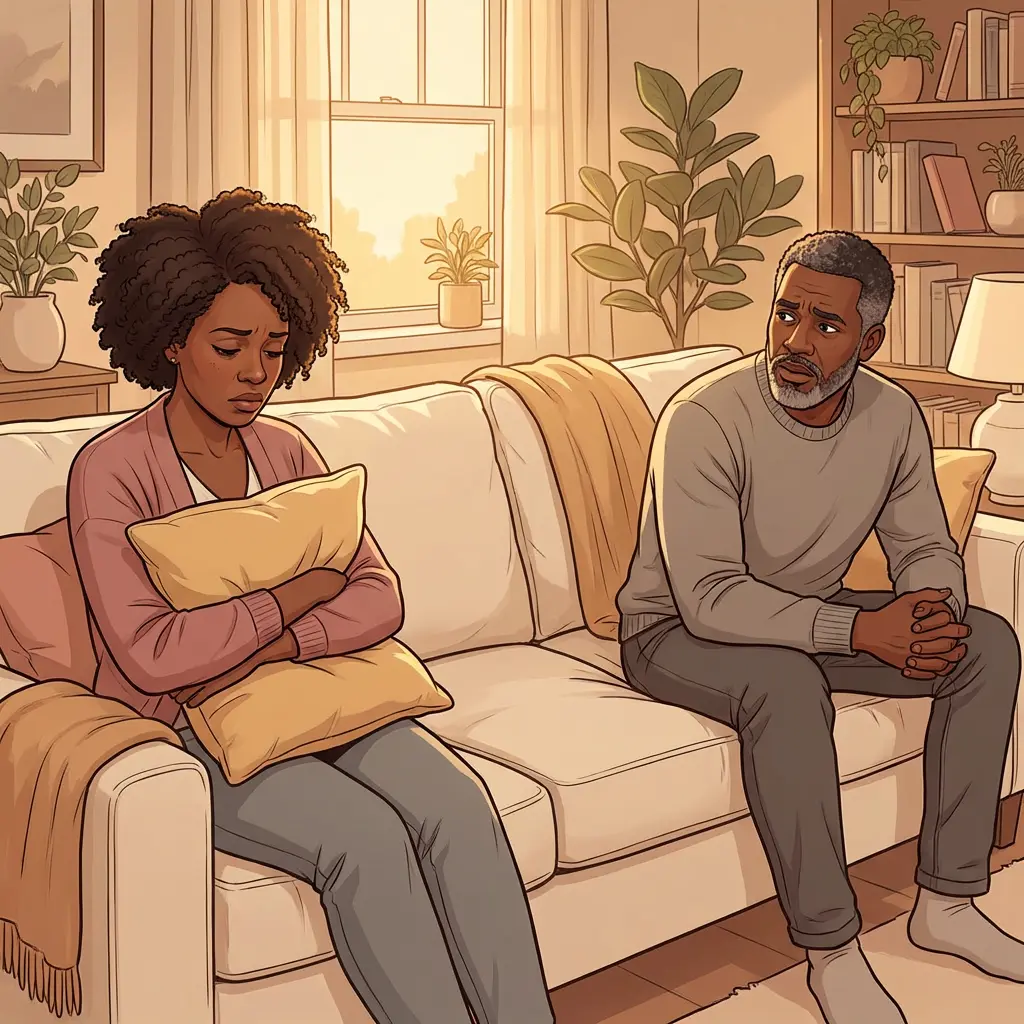

Rage, Withdrawal, and a Growing Distance Neither of You Understands
The anger came first. Not the normal frustration of a long partnership — something deeper, hotter, and harder to control. You snap at things you used to shrug off. You fantasize about being alone. Your partner's breathing annoys you. And underneath the rage is grief, because you know this isn't who you are — but you can't seem to stop.
Then desire disappeared. Not gradually — like someone flipped a switch. Your partner reaches for you and you feel nothing. Or worse — you feel irritated. Sex became uncomfortable. Vaginal dryness makes penetration painful. Your body doesn't respond the way it used to. And the distance this creates feeds into everything else.
The withdrawal is the most insidious part. You stop sharing. You stop initiating. You go to bed early and wake up relieved that they're already gone. Your partner interprets this as rejection — because that's what it looks like from the outside. But from the inside, you're not rejecting them. You're drowning and don't have the energy to explain.
54% of women with menopause symptoms report impact on their sex life or relationships. 46% report reduced libido. 35% report vaginal dryness. These aren't character flaws or relationship failures — they're symptoms. And symptoms are treatable.
"My husband thought I was falling out of love. I thought our marriage was over. Turns out my serotonin and testosterone had tanked. Three months on HRT and we found each other again. The love was never gone — the hormones were."
— Age 49
Why Menopause Creates Relationship Conflict — the Hormonal Mechanisms
RAGE AND IRRITABILITY: Estrogen modulates serotonin (mood regulation) and GABA (calming). When estrogen fluctuates wildly during perimenopause, your capacity for emotional regulation is physiologically reduced. The irritability isn't a choice — it's a neurochemical state. Progesterone decline removes the GABA-mediated calming buffer. The result is a shorter fuse, bigger reactions, and less access to the cognitive perspective that normally prevents you from saying the hurtful thing.
LOW LIBIDO: Testosterone drives desire. Estrogen maintains vaginal tissue, lubrication, and blood flow to the genitals. When both decline, desire drops AND physical arousal becomes difficult AND sex can become painful. It's a triple mechanism: psychological (no desire), physiological (reduced arousal response), and structural (vaginal atrophy and dryness). Addressing only one mechanism produces limited results.
EMOTIONAL WITHDRAWAL: When you're exhausted (progesterone decline disrupts sleep), foggy (estrogen decline impairs cognition), and emotionally raw (serotonin and GABA are depleted), social engagement requires energy you don't have. Withdrawal isn't rejection — it's conservation. Your nervous system is in a survival mode that prioritizes essential functions and drops 'optional' ones like emotional connection.
PARTNER CONFUSION: Your partner sees the changes but doesn't understand the mechanism. They interpret rage as hostility, low libido as rejection, and withdrawal as falling out of love. Without understanding the hormonal root, they personalize what's actually physiological. This creates a cycle: your symptoms create distance, their response to the distance increases your stress, and stress amplifies your symptoms.
How It Happens
When Couples Therapy Isn't the Right First Step
Many couples in the menopause transition turn to couples therapy — which is valuable but may not address the root issue. If the relationship conflict is primarily driven by hormonal rage, hormonal libido loss, and hormonal exhaustion, therapy provides communication tools for a problem that's physiological. It's like doing conflict resolution about headaches when the actual problem is high blood pressure.
This isn't anti-therapy. Communication skills, emotional validation, and structured conversations about changing needs are genuinely important during the menopause transition. But therapy works best AFTER or ALONGSIDE hormonal treatment — when the neurochemical environment supports the emotional regulation that productive therapeutic work requires.
The partner communication gap is real. Most partners (particularly male partners) know almost nothing about menopause. They may know it involves hot flashes and eventually periods stop. They don't know about rage, cognitive changes, libido mechanisms, insomnia, or the 4-12 year duration of perimenopause. Education is an intervention — when partners understand the mechanism, they stop personalizing the symptoms.
There's a pattern we see frequently at Pause & Reset: a woman comes in for menopause evaluation mentioning relationship strain as a secondary concern. Three months into treatment, she reports that the relationship has healed — not because they went to therapy, but because the rage subsided, desire returned, energy improved, and she could engage again. The relationship was never broken — the hormones were.
"I was so angry at him all the time and couldn't explain why. He couldn't do anything right. When my hormones were treated, the rage just... dissolved. He was the same person. I was the one who'd changed — and changed back."
— Age 47
Rage + Relationship Conflict
Irritability and rage during perimenopause are serotonin/GABA-mediated, not personality changes. Partners who understand the mechanism stop personalizing the anger.
Ask about: Hormonal evaluation + partner education session
Low Libido + Intimacy Breakdown
Testosterone drives desire. Estrogen maintains vaginal comfort. When both decline, intimacy becomes a source of anxiety rather than connection.
Ask about: Testosterone + estrogen evaluation + local estrogen options
Painful Sex + Avoidance Cycle
Vaginal dryness and atrophy make sex uncomfortable or painful. Avoidance follows. Partner feels rejected. The cycle deepens without treatment.
Ask about: Local estrogen therapy + vaginal health assessment
Emotional Withdrawal
When you're exhausted, foggy, and emotionally raw, social engagement requires energy you don't have. Withdrawal isn't rejection — it's conservation.
Ask about: Sleep, energy, and comprehensive hormonal evaluation
When to See a Provider Promptly
- •Relationship violence or threats — seek safety resources immediately (National Domestic Violence Hotline: 1-800-799-7233)
- •Persistent painful sex that doesn't improve with lubricants — vaginal atrophy evaluation needed
- •Partner depression or withdrawal in response to changes — consider partner support resources
Protecting Your Relationship Through the Transition
GET TREATED. This is the single most impactful relationship intervention available. When rage, low libido, exhaustion, and withdrawal have hormonal roots, hormonal treatment addresses the root. The communication, reconnection, and intimacy improvements that follow treatment are often described as 'getting my wife back' by partners — and 'getting myself back' by the women themselves.
EDUCATE YOUR PARTNER. Share this page. Share the mechanism. The moment your partner understands that your irritability is serotonin, not hostility — that your libido change is testosterone, not rejection — that your withdrawal is exhaustion, not falling out of love — the dynamic shifts. Understanding depersonalizes the conflict.
HAVE THE CONVERSATION. 'Something is happening to my body that's affecting our relationship. It's not about you. It's hormonal. I'm going to get help, and I need you to know that I'm not choosing this.' This conversation — honest, vulnerable, specific — is more powerful than most couples realize. Most partners respond with relief and willingness to support when they understand the mechanism.
ADDRESS INTIMACY DIRECTLY. If sex is painful, say so. If desire is absent, name it. If you need different kinds of touch — non-sexual affection, physical closeness without expectation — ask for it. The avoidance cycle (sex is uncomfortable → you avoid it → partner feels rejected → tension builds → avoidance deepens) can only be broken with direct communication. And vaginal dryness and atrophy are treatable — often rapidly with local estrogen therapy.
Symptom Tracker — Relationships & Marriage
Track these for 2–4 weeks before your appointment
💾 Save this tracker — bring it to your first appointment
We Welcome Partners in the Conversation
At Pause & Reset, we understand that menopause doesn't happen in isolation — it happens in families, partnerships, and communities. When a woman's hormones change, everyone around her is affected. We welcome partners who want to understand the mechanism and participate in the treatment journey.
Dr. Nina frequently explains the hormonal mechanisms to partners — either in joint appointments or through educational materials — because understanding the physiology is therapeutic for the relationship. When a partner hears 'her irritability is caused by the same neurotransmitter mechanism as an anxiety disorder' rather than 'she's angry at you,' the entire relational dynamic can shift.
We address every mechanism: estrogen and progesterone for mood regulation, testosterone for desire, local estrogen for vaginal health, sleep optimization for energy, and nutritional support for overall resilience. The goal isn't just symptom management — it's restoring the capacity for connection, desire, and partnership that perimenopause can temporarily suppress.
If you're in Atlanta and your relationship is suffering from what you suspect might be menopause-related changes — you're not alone, you're not wrong, and you're not broken. The hormonal mechanism can be evaluated and treated. And when it is, most couples find each other again. Because the love wasn't gone — the hormones were.